


Top Tips for Painting Skies in Watercolour with Stephen Coates
Stephen Coates is a full-time artist, specializing in painting with watercolours. Stephen has authored several books for Search Press, and we caught up with him to learn a little about how to paint stunning skies based on the techniques learned in his brand-new book, The Easy Guide to Painting Skies in Watercolour.
"Creating a really good sky with watercolour paint needn't be difficult even though the vast majority of leisure painters and amateurs seem to make a meal of it with very patchy results. I have just written a book called The Easy Guide to Painting Skies in Watercolour which has 112 pages and took two years to compile. It just isn't possible to cover everything in a short blog like this so I'm going to give you some important ground rules and exercises to follow which should give you a good start.
Let me share with you what I consider to be the most important things to understand before embarking on a watercolour sky. It's all about timing!


Nature's time limit
1. The whole area of a watercolour sky should be alive with active water which forms, mixes, and blends the colours introduced by the artist. High water levels may appear to be out of control but should not be feared. This active film of water on the paper is the lifeblood of a successful sky.


2. A film of water will soak into the paper and evaporate very quickly. It will only remain active and affect the pigments for a limited time. Once the water has gone the paint can no longer be manipulated by the artist. Nature therefore provides a time limit which most would agree is around two minutes. This may seem a bit scary but there is no need to panic. Two minutes is a lot longer than you think.
3. It isn't possible to paint a large area of sky in two minutes with small conventional brushes. Therefore, a much larger brush is required in order to deliver the paint more quickly before it dries. Each artist has a favourite, but most choose something with really soft hair which allows more water into the brush head and provides a more delicate touch.

4. If we only have a limited amount of time to get the paint on, a well-prepared palette is vital. Once the sky has been started, you simply won't have time to prepare paint if you have forgotten to mix a colour or squeeze out more paint from a tube if you have an insufficient amount.

5. And finally, never retouch or attempt any improvements once time is up. To quote from my book, “The initial placement of the paint is done with a brush. The final resting place of the paint is determined by the active water.” Constant fiddling will ruin a perfectly good sky. You just have to let it settle and accept the outcome, even if it wasn't what you intended.

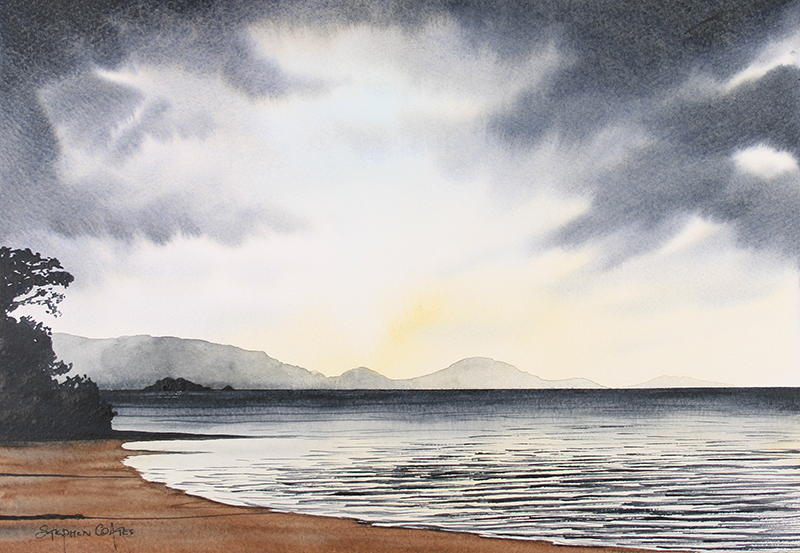
These are all very important messages, and it is quite difficult to remember all of this every time you paint a sky. I always wanted to publish a book dedicated to watercolour skies and now I have had the chance to fulfil that dream.
The Easy Guide to Painting Skies in Watercolour is a powerful set of explanations, rules, disciplines, exercises, and projects that you will be able to refer to over and over again each time you want to paint a new sky. I hope it helps you become more proficient and that you enjoy every image and every word!"
For more information about Stephen and his upcoming workshops visit www.coatesart.co.uk
The Easy Guide to Painting Skies in Watercolour is available from Search Press, RRP £9.99

About the Author

Stephen Coates
Stephen Coates was born in Sheffield in 1960. The son of a draughtsman, he was introduced to drawing...